
You can now simulate windshield defog and fogging scenarios, refine fluid meshes where they matter most, and run two-way transient coupling with system models without transient restarts. The ThermoAnalytics 2026.2 release of TAITherm, MuSES, and CoTherm brings moisture transport to RapidFlow, faster and more flexible meshing, and a new CoSolver mode to CoTherm for coupled workflows.
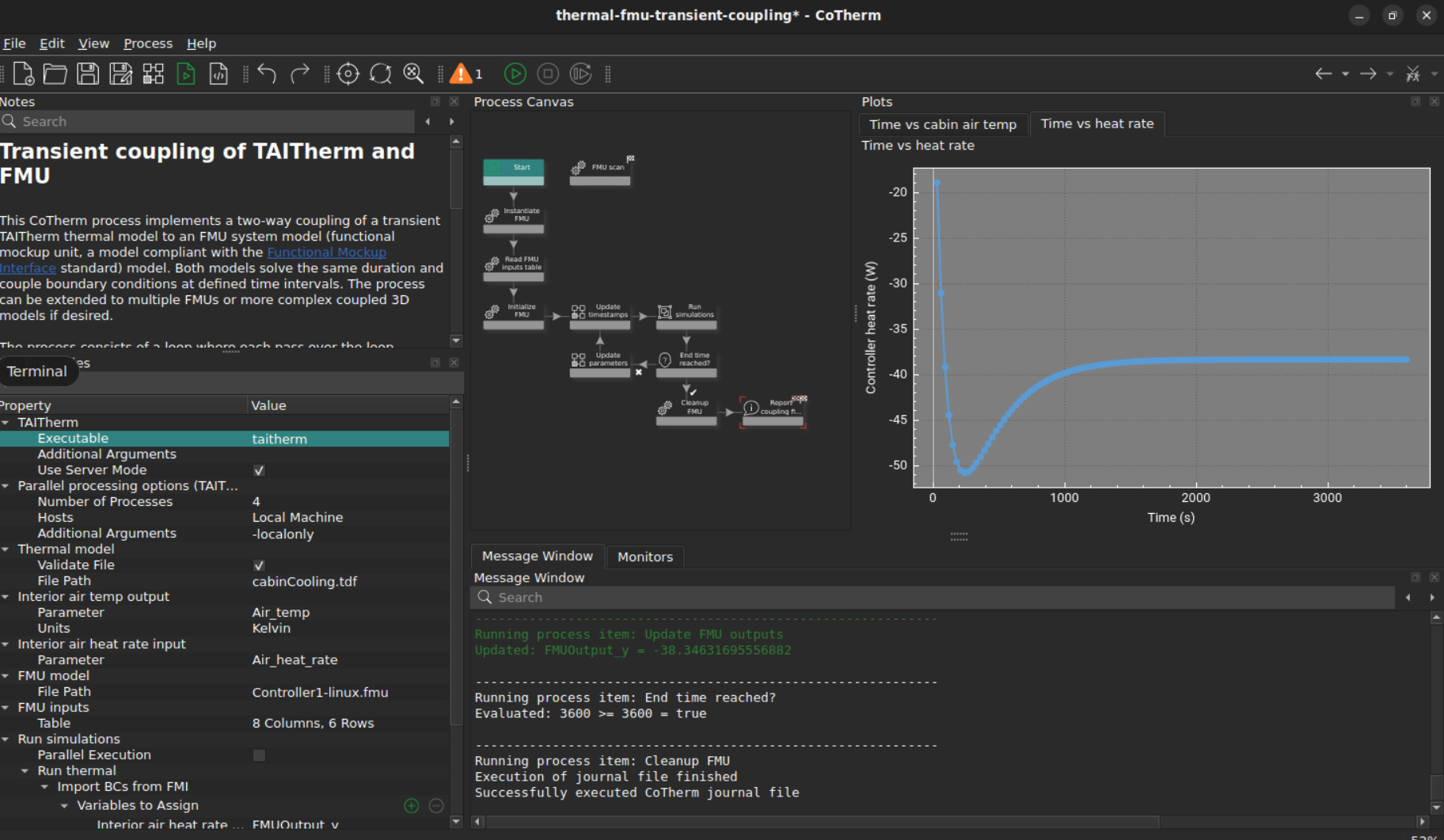
CoTherm 2026.2 introduces CoSolver mode for TAITherm, giving you faster run times and two-way transient coupling with system and 1D models without transient restarts.
TAITherm CoSolver Support
- CoSolver mode for faster, more efficient coupling. TAITherm tools now support CoSolver mode, which improves simulation run times and enables efficient coupling without requiring transient restart. In a TAITherm and FMU coupling example, CoSolver mode ran three times faster than interactive batch mode. You turn it on with the new Execution Mode property, which replaces the previous Use Server Mode option. If your PMDs or Journal scripts reference serverMode, update them to use the executionMode Journal string.
- Parameter-based two-way transient coupling. In CoSolver mode, CoTherm can run TAITherm models, assign TAITherm Input Variables from Input Parameters, and update TAITherm Result Variables from Output Parameters. That enables parameter-based, two-way transient coupling with system and 1D models, along with similar processes.
Comments
0 comments
Article is closed for comments.